Peas
If you like short head-to-head card duels with a cute theme, Peas will probably appeal. It puts two players across from each other, each trying to collect the most valuable "pea" tokens by quietly building up a set of ten face-up plays and only learning which tricks you actually won once the round finishes. The game feels small and charming, but it is not without flaws. Here’s a friendly walkthrough and our thoughts after a few plays.
Quick setup
Sit opposite each other and place your player card in front of you showing the sprout side.
One player takes the start marker.
Ten pea tiles are laid in a row between players, with pod pieces framing the ends. Flip the peas face up.
Shuffle the numbered suit cards and deal ten to each player. These are your hidden hands for the round. Extra cards are removed.
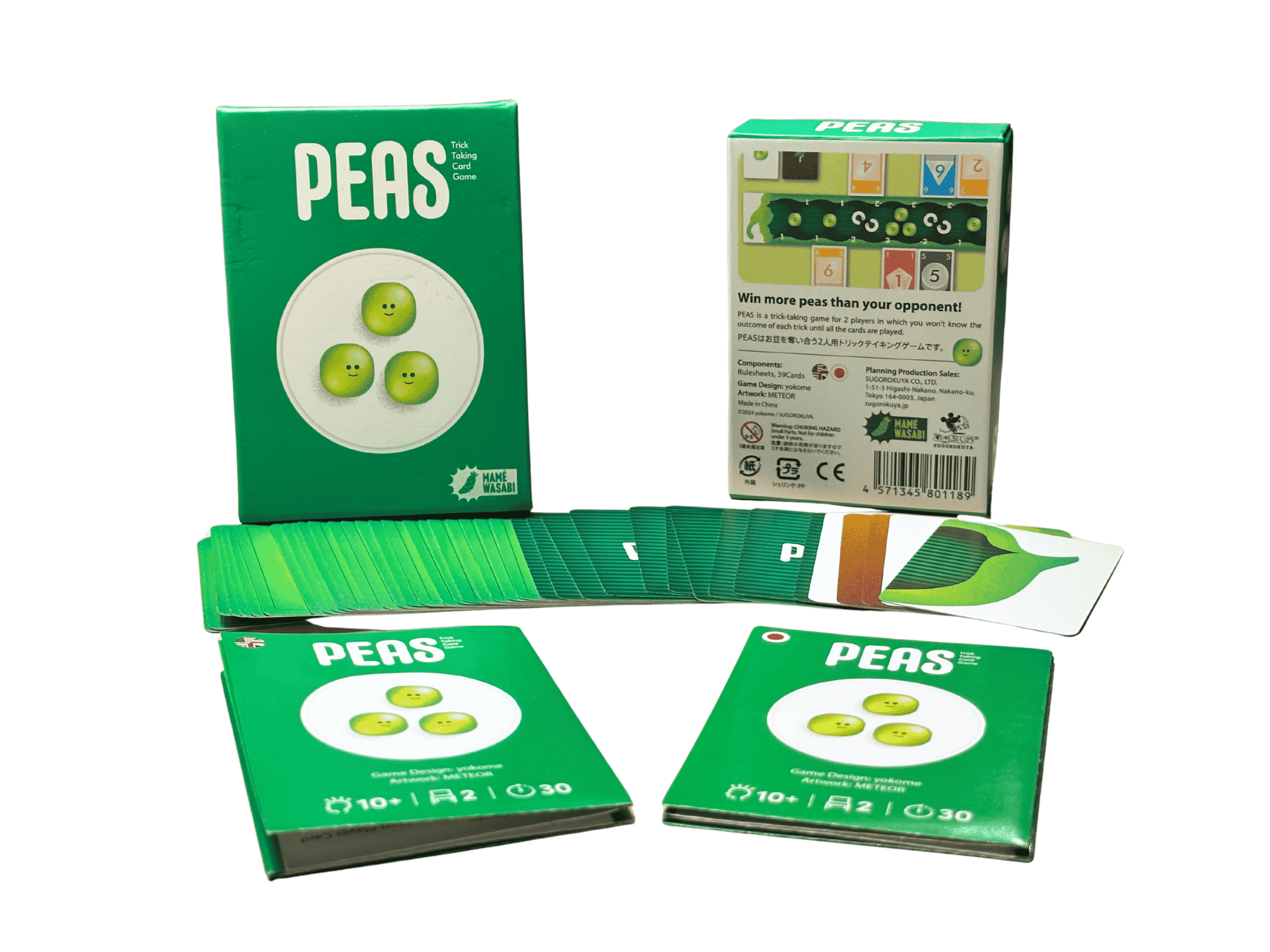
The components of Peas: cards, instruction books in English and Japanese, and the box.
How a round plays
A match is best-of-three rounds. Each round, players take turns placing one of their ten cards under any pea tile, on their side of the table. The starter places first. You put cards face-up beneath peas and work toward resolving which side wins each pea at the end of the round.
Rules for what you may play:
If the opposite side of a pea is empty, you may play any card under it.
If the opponent has already played a numeric card there, you must follow with a card of the same color when possible.
If you have no card of that color, play any other card.
Play continues until both players have placed all ten cards. The order in which cards are played matters because it determines which plays are closest to the stem and thus the order of trick resolution.
The stem and why order matters
A special stem marker sets which suit will count as the initial leading color during scoring. The first player to place a numbered card nearest to the stem captures the stem for their side. During scoring you work outward from the stem, checking each paired play to see who wins that pea.
Scoring the peas
Once all ten cards are placed, reveal how tricks resolve starting at the card nearest the stem:
If both cards on a pea are the same color, the higher number takes the pea.
If the colors differ, the current lead color captures it.
The winner of each pea gets that tile and its point value. Peas have positive points while worms subtract points.
After the first trick is resolved, the side that won that trick determines the lead for the next pair, and so on until every pea has been decided. Tally up the pea points. The round winner is the player with the higher pea total. Ties are broken by who held the start marker. If a player ends the round having not taken any pea tiles at all, there is a special condition that can affect the outcome as defined in the rules.
To mark a round win, flip your player card to the flower face. Flip twice and you win the match.
What it feels like to play
Peas is compact and sweet. The whole round is a tension between hidden hand management and timing. You must decide where to commit your limited high numbers, when to refuse the lead, and which peas are worth risking a strong card for. Because the tricks are only resolved after all plays are made, bluffing and second-guessing your opponent are part of the fun.
That said, the tactical horizon is modest. Often the optimal move is simply to beat the opponent on a given pea if you can. There is room for clever placement and trying to manipulate the lead order, but deep, multi-layered strategy rarely develops in a single round.
Design and components
The presentation is one of the game’s strengths. Art and components lean into the garden theme in a friendly, minimal way. The set is small and unobtrusive on the table. Rules language could use polishing, because the way certain procedures are described can be confusing on first read. With a quick playthrough or two, most of the ambiguity clears up.
Strengths
Easy to teach: core play is intuitive once you have done one round.
Fast rounds keep the game moving and make for pleasant rematches.
Charming visual identity makes it an appealing coffee-table choice.
Weaknesses
Rule text is not optimally written and can trip up new players. Expect to clarify a few points aloud during your first game.
Limited strategic depth. You can plan and influence outcomes, but gameplay often reduces to playing the higher card when you have it.
The scoring and lead mechanics require attention; misreadings are common if you are trying to teach the game on the fly.
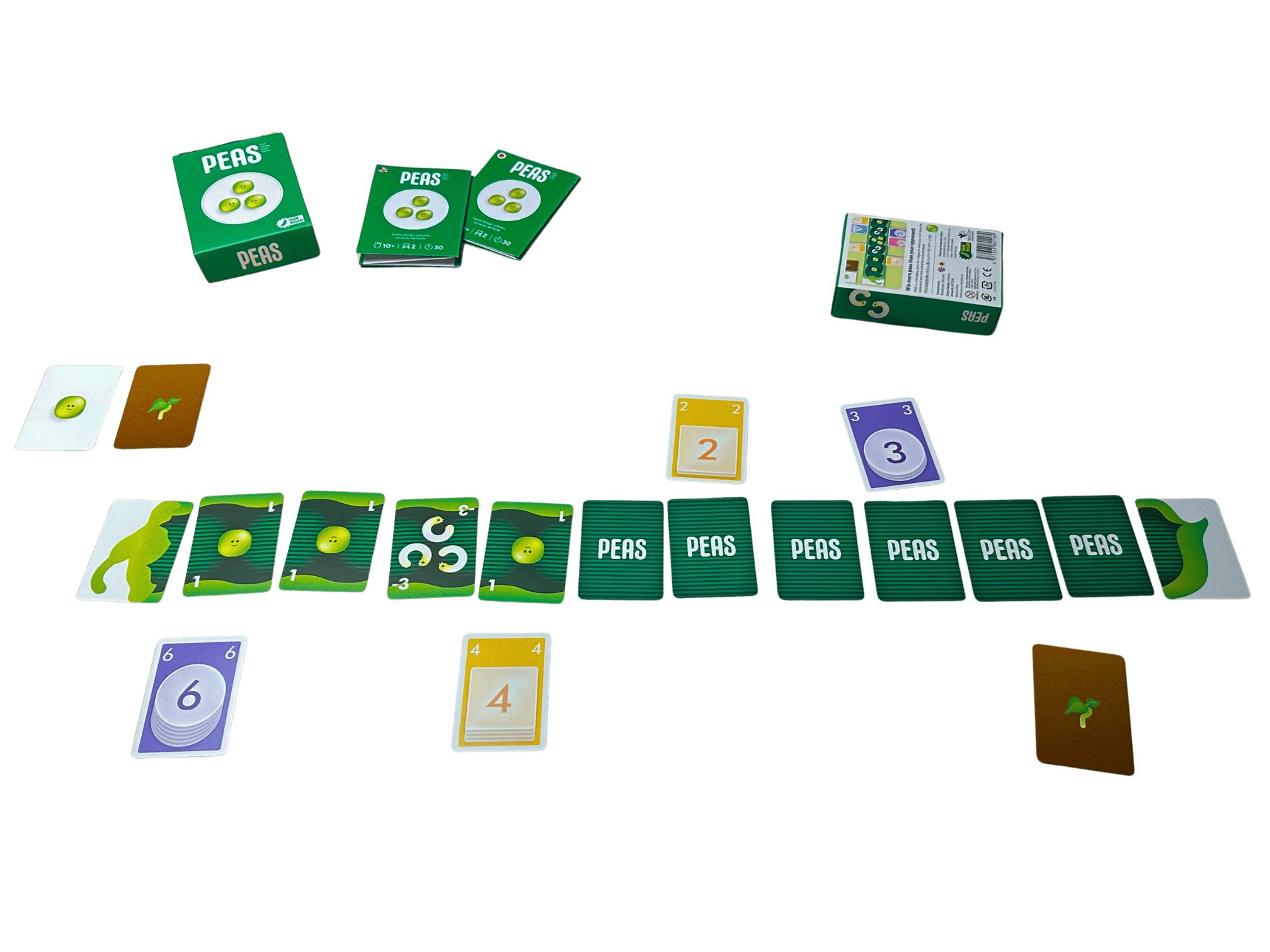
Peas: the card setup during a game
Final thoughts
Peas is a lovely little two-player filler that hits its marks for accessibility and style. If you want a short, low-pressure head-to-head where placement timing matters, it will deliver. If you crave intense tactical puzzles or a game that rewards long-term strategy, this is not the deepest option on your shelf.
To sum up: the game is simple to master, though the rulebook could be clearer and better organized; the aesthetic and component design are cute and straightforward; and mental challenge is limited because many turns boil down to playing any higher card you can. It is friendly and approachable, but does not aspire to be a heavyweight brainteaser.
Overall score: 6.5 / 10
If you liked this review, don’t miss out on new game releases! Subscribe now to the newsletter.
