Sacra Maioritas
Sacra Maioritas – The Holy Majority is a smart, ambitious card game with a strong identity and a clever core system. The rondel-based structure, shifting ritual faction, hidden goals, and influence management all combine into something that feels fresh and thematic. It is the kind of design that clearly rewards planning, reading the table, and adapting on the fly.
That said, it does take some time to get comfortable with the rules. There is a lot happening at once, and the first few plays can feel dense before the logic of the rituals, factions, and scoring starts to click. Once it does, though, the game reveals a very satisfying structure beneath the complexity.
The artwork, however, is a mixed point. Some of the images have a noticeable AI-generated feel, which takes away a bit from the otherwise serious and historic atmosphere. A dedicated human designer or more cohesive artistic direction would have given the game a much stronger quality finish and helped the presentation match the intelligence of the gameplay.

Coins of Sacra Maioritas
Rules Summary
The game is played over three Conclaves, each consisting of a series of Rituals (ten in most cases, eight in a 4-player game). Players aim to accumulate the most Influence across these Conclaves.
At the start of each Conclave, players are dealt a hand of faction cards (Faithful, Scholars, Nobles, Shadows), and a set of cards is arranged face-up in a circular “Rondel.” A Fate Marker and a Seal Marker are placed on this rondel, defining which cards can be selected during play.
Each Ritual follows a structured sequence:
The Call of Fate: The current leader moves the Fate Marker along the rondel. Moving one space is free, but additional steps cost increasing amounts of Influence. The marker cannot pass or land on the sealed card (except in the final ritual). The card it lands on determines the Ritual Faction and counts as an already-played card.
The Offering of Cards: Players, starting with the leader, play one card. If they have cards matching the Ritual Faction, they must play one. Otherwise, they may play another faction (with restrictions related to the sealed faction).
Revelation and Judgment: The winning faction is determined by majority (including the Ritual Card). Scholars win ties; otherwise, the highest card decides. If the winning faction differs from the Ritual Faction, the result becomes a Coup. Leadership passes to the player who contributed the highest card of the winning faction (or clockwise if none).
Special rules apply in edge cases, such as when a player only holds sealed faction cards, triggering “Temptation” or “Scorch of Faith,” which can alter scoring and card play.
After each Ritual, Influence is awarded:
Standard wins reward the leader and supporting players of the winning faction.
Coups reward coup participants but penalize players who followed the original Ritual Faction.
Each faction also has unique scoring modifiers (e.g., Faithful grant bonuses, Nobles reward only the highest card, Shadows penalize non-participants).
At the end of a Conclave, players may reveal Oath cards (if used) for bonus Influence. Scores are recorded, then reset for the next Conclave with new hands, a new rondel, and potentially new Edict modifiers.
After three Conclaves, the player with the highest total Influence wins. Ties are broken by performance in the final Conclave, and if still tied, multiple players share victory.
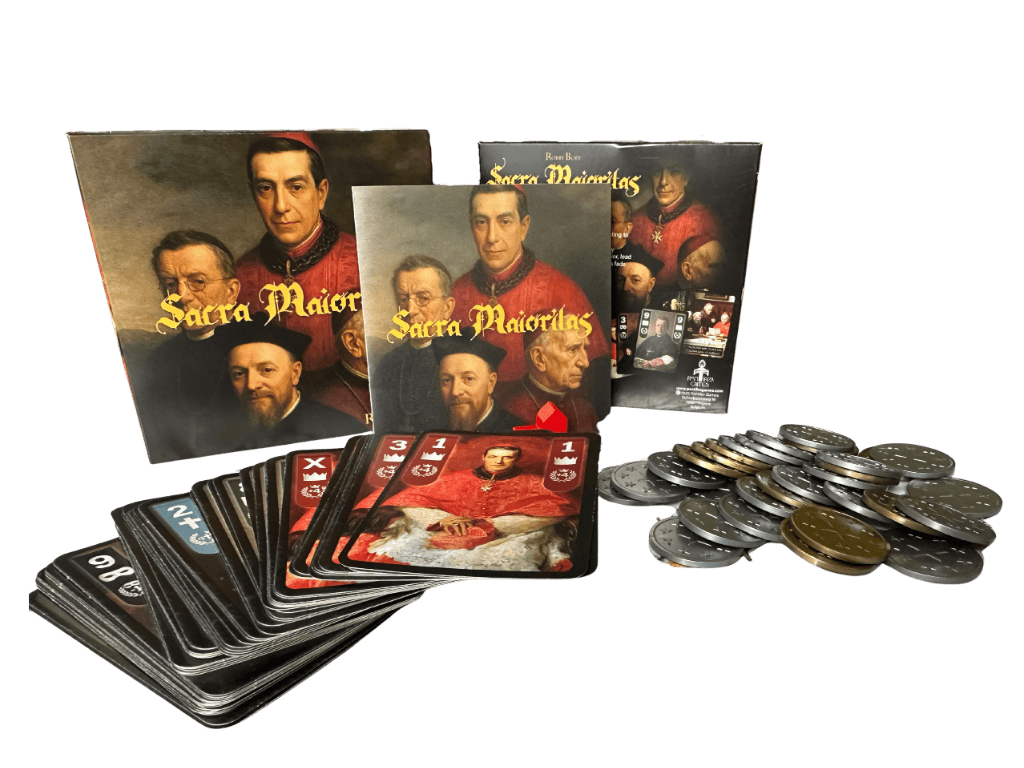
Full set - Sacra Maioritas
Verdict
Overall, Sacra Maioritas is a well-designed game with real strategic promise, but its presentation keeps it from feeling fully polished.
Rating: 7.5/10
