Burnout
Context
You are one of a handful of coworkers clawing your way to a promotion. Build Reputation, protect your Mental Health, and survive six chaotic weeks. Highest Reputation after Week 6 wins. If your Mental Health hits zero, you Burnout and pay a steep price: -7 Reputation, reset Mental Health, lose your hand, and miss your first turn next week. During the game, you can play nice or play dirty, the choice is yours.
Why you’ll love it
Burnout nails the office tone: the box, the components, and yes, the rulebook (described as ‘’the only useful HR manual’’) all speak the same language. The cards, meeples, and boards feel intentionally crisp and a little too real, and that consistency makes every backstab land with a satisfying, slightly guilty chuckle.
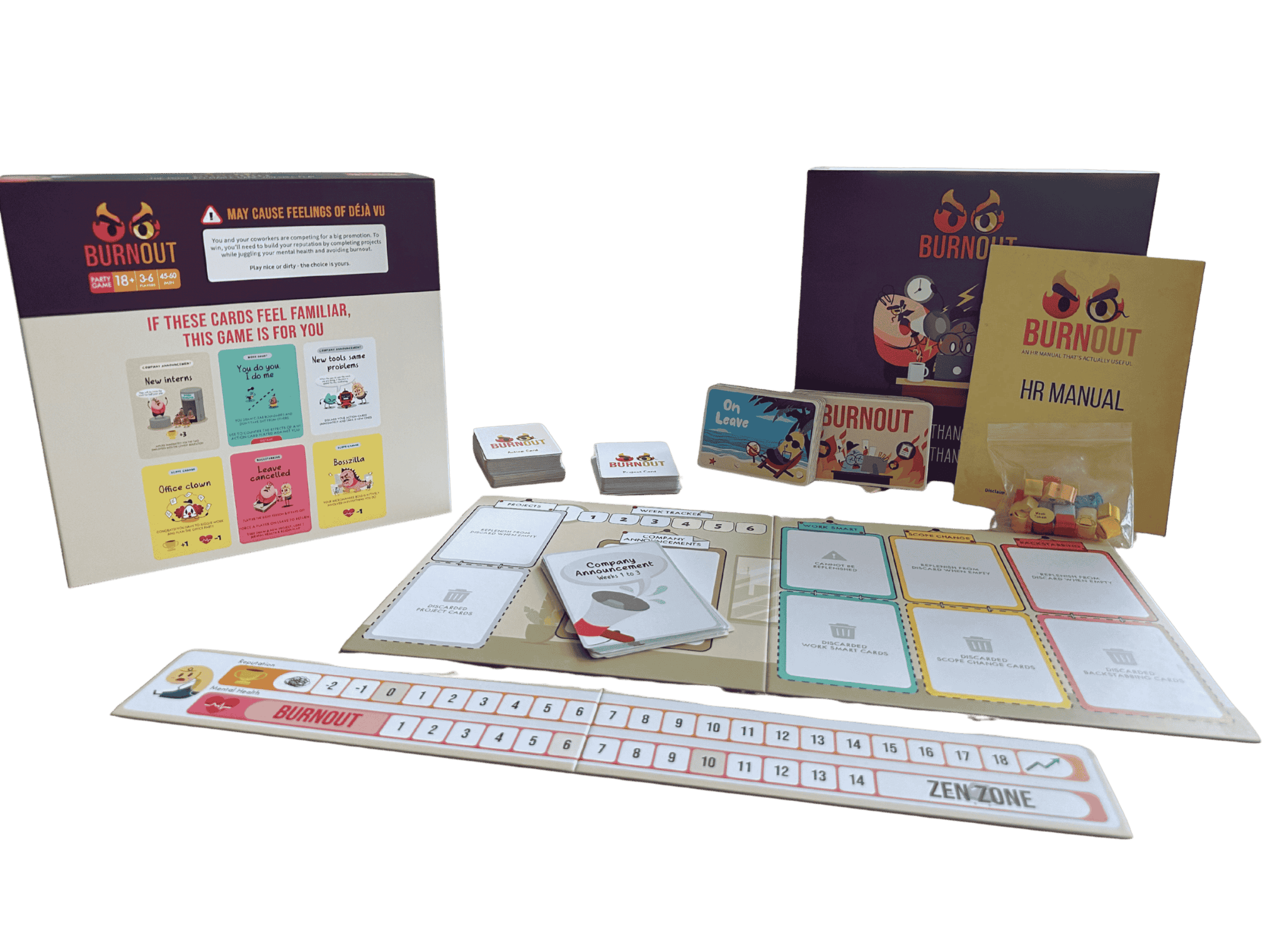
The components of the game ‘Burnout’
What stands out among the components:
Project cards give you Reputation and cost or heal Mental Health (scored only at the end of each week).
Scope Change cards attach to Projects and stick to them when Projects are stolen or reassigned.
Backstabbing cards let you mess with people immediately.
Work Smart cards protect you, and they can counter counters (which creates juicy stackable drama).
Annual Leave cards are scarce but powerful for a mental reset.
How a game actually flows
Setup has a few steps, but once you start, the table becomes deliciously chaotic. Each week you draw Projects, refill your hand up to the week’s limit, reveal a Company Announcement that shakes things up, then take turns playing one Action card or skipping until everyone skips in a row. At the end of the week you tally Reputation and Mental Health (including any Scope Change attachments), clean up, and move the Week token forward.
What could be better
The designers got the tone and mechanics right, but the weekly ritual of draw-play-skip-tally sometimes feels a little procedural, like clocking in. That’s not the same as a rules problem; the game is fine technically. It’s that the game’s rhythm could use more zing, something to make each week feel like its own story arc instead of a repeatable loop. We felt that the sense of excitement and novelty in each round was constrained, perhaps due to the limited sense of making tactical decisions.
Additions that would help: a mandatory midweek event, tighter triggers on Company Announcement cards so they escalate, or a mini-objective each week that gives a one-off twist (e.g., extra Reputation or a forced swap). However, the number of decks should still be kept to a minimum, as in this game you will already be handling several sets of cards. The rules give you everything you need, but the pacing could be tuned to make every single week feel as dramatic as the final showdown.
The rules (a general overview)
Set up: Place the Week token on Week 1, pick a character, place Reputation at 0 and Mental Health at 10, and shuffle the decks. Build the Company Announcement deck by mixing Weeks 1-3 and Weeks 4-6 as instructed.
Start: The player with the most recent toxic work experience goes first (always clockwise). Draw 1 Project face-up and draw your starting Action cards (week-dependent hand limit). Reveal the week’s Company Announcement.
Take turns: On your turn you can play 1 Action card, or skip. Play continues until everyone skips in a row.
End-of-week: Tally Project Reputation and Mental Health, update your boards, discard Projects and Scope Change attachments, advance the Week token, refill hands up to the limit, and repeat.
Burnout: Hit Mental Health 0 and you immediately take the penalty: add the week’s Reputation if not already added, but lose 7 Reputation points, reset Mental Health to 6, and discard all Action cards. Next week draw only 3 Action cards, miss your first turn, then resume.
Strategy tips
Don’t risk your Mental Health for tiny Reputation gains. Build a cushion.
Start playing politics. Steal Projects that have Scope Changes you can benefit from.
Annual Leave: Use as a strategic retreat, not an escape. If you dump toxic Projects onto others, you might win by being the least burned.
Final verdict
Burnout is clever, funny, and thematically tight. Players who enjoy social interaction, light math, and the joy of polite sabotage will get a lot out of this. It loses a little polish where pacing is concerned: the weekly loop can feel repetitive unless your group adds house rules.
Pros:
Perfect theme execution and component quality.
Deep, replayable interactions with counterplay and sticky modifiers.
Relatable moments that make players laugh and groan in equal measure.
Cons:
Week pacing needs a bit more excitement to match the tone elsewhere.
Final thought
Burnout is a sharp commentary on work culture that also happens to be a satisfying game. If your group likes social maneuvering and a dash of cruelty wrapped in corporate satire, this belongs on your shelf. If you want every week to feel like a narrative beat, add a house-rule or two to punch up the rhythm, as we found the pacing to not be exactly it. Either way, bring snacks and a good sense of humor.
Final rating: 7/10.
Would you like to be updated on the latest game releases? Subscribe to our newlsetter now!
